A consumers wants and needs is the driving motivation behind the question “why did you purchase that product? and what made you purchase the product?” it’s what makes consumers purchase a particular product in which they not only want but think they need. This is manifested within an individual through their drive which is the degree of arousal present due to a discrepancy between the consumer’s present state and some ideal state and their wants which is displayed through the need created by personal and cultural factors (Anon 2014; Fennell, 1978).
In the last decade studies have been conducted such as Nielsen’s 2014 global survey on Corporate Social Responsibility, results show that 55% of people are willing to pay extra for products from companies committed to making positive social and environmental impacts and reduce their carbon footprint (Spivey 2019). It has also shown that millennials want companies do their part in addressing issues such as health, the economy, and environmental sustainability in the way that they produce and deliver their products, which shows that this new generation drastically differs from the last as there wants and needs has shifted to caring for the world we live in today not only for the present but for the future generation also (Anon 2014, Spivey 2019).
In addition to Nielsen’s study, a more recent study conducted by Cone communications (2017) has found an increase in consumer wants and needs and choice becoming more environmentally sustainable as it found that “87% of consumers will have a more positive image of a company that supports social or environmental issues, 88% will be more loyal to a company that supports social or environmental issues, 87% would buy a product with a social and environmental benefit if given the opportunity and 92% will be more likely to trust a company that supports social or environmental issues.”
Because of this, Patagonia have positively explored this as their products are longer lasting meaning they do not need to be thrown away as they also recycle certain materials and make their product such as a jacket out of it, meaning that the material is re-used and not thrown away which results in less damage to the environment as fewer products are being dumped onto the environment or garbage landfills. Thus, Patagonia successfully do so as its customers can live in a more environmentally responsible way which has seen them, as a company, become extremely successful all over the world.
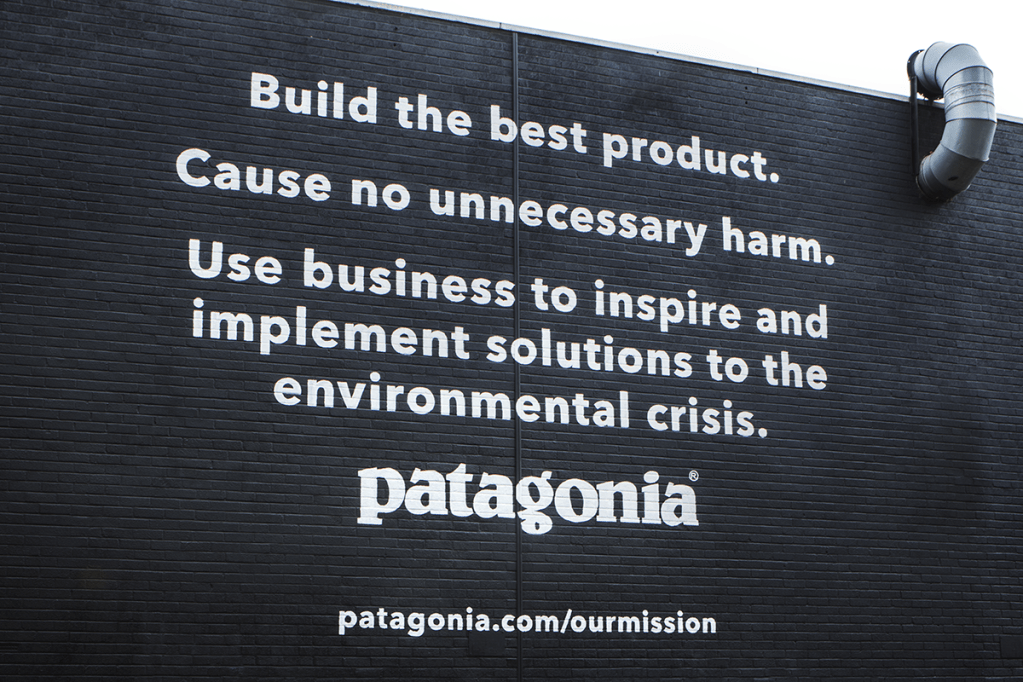
Because of this new found demand of companies being environmentally sustainable which is proven by the literature above, it is made evident that Patagonia successfully appeals to the determinant of need of the physical characteristics of the environment such as climate, whilst also appealing to the environmental context within the determinant of wants. Thus together, it satisfies the consumers needs and wants which drives Patagonia to success as they appeal to consumers to ‘buy less’, bringing about a sense of positive incentives as and self and fulfilment as the consumer knows that by purchasing Patagonia’s brand they are bettering the environment and making a positive social impact of change.
Reference:
(1) SAGE Journals. (2019). ‘Sustainable Marketing’, Ynte K. van Dam, Paul A. C. Apeldoorn, 1996. Accessed 6 May 2019 <https://journals.sagepub.com/doi/pdf/10.1177/027614679601600204>.
(2) Anon, (2014). ‘The concept of green marketing and green product development on consumer buying approach’, Accessed 6 May 2019, https://www.researchgate.net/profile/Assc_Prof_Dr_Rashad_Yazdanifard/publication/268747494_THE_CONCEPT_OF_GREEN_MARKETING_AND_GREEN_PRODUCT_DEVELOPMENT_ON_CONSUMER_BUYING_APPROACH/links/547561a10cf245eb4370c673/THE-CONCEPT-OF-GREEN-MARKETING-AND-GREEN-PRODUCT-DEVELOPMENT-ON-CONSUMER-BUYING-APPROACH.pdf
(3) Spivey, S. (2019). ‘How Patagonia is using Cause Marketing to define their brand and drive sales – Bazaarvoice blog’. Accessed 6 may 2019, <http://blog.bazaarvoice.com/2015/07/07/how-patagonia-is-using-cause-marketing-to-define-their-brand-and-drive-sales/>.
(4) Fennell, G., 1978. ‘Consumers’ Perceptions of the Product—Use Situation: A conceptual framework for identifying consumer wants and formulating positioning options’. Journal of Marketing, 42(2), pp.38-47. https://journals.sagepub.com/doi/abs/10.1177/002224297804200207?journalCode=jmxa
(5) Nielsen N.V. 2014. ‘ Doing well by doing good’, The Neilson company, New York USA and Diemen The Netherlands, https://www.nielsen.com/content/dam/nielsenglobal/jp/docs/report/2014/Nielsen%20Global%20Corporate%20Social%20Responsibility%20Report%20-%20June%202014.pdf
(6) Cone Communications, 2017, ‘Cone communications CSR study, Cone communications, Boston USA, http://www.conecomm.com/research-blog/2017-csr-study#download-the-research


