Have you ever considered why people buy brand name products or why they forge hundreds or even thousands of dollars on a pair of socks or undies? Why are they so concentrated on having the most expensive stuff? isn’t just a name right like Gucci or Tommy Hilfiger? Well the answer to this relates to an individual’s or company’s self-esteem, self perception and even the personality traits of the individual and company. The type, design, material, and way clothes are produced and worn play a significant role in influencing someone’s self-esteem, self perception and personality, not only on the individual but also towards the business providing the clothes which is all due to a significant increase in consumer consumption as clothing has become more of a disposable product within the world.
Thus, because of this, our self perception and self-esteem can be dramatically changed or persuaded by our exposure to the media and marketing campaign undertaken (Mehta 1999). Another major contributor is social comparison which is where consumers evaluate themselves by comparing themselves with others (Moschis 1976 and Mehta 1999). For example, in Mehta (1999) study it found that the “purchase intent was found to be stronger for respondents whose self-image and perceived brand image are congruent”. Meaning that when the customer within themselves felt that the company’s product satisfies or improves their self worth and self image they are more entitled and motivates to spend the extra money to purchase this products. This is shown within
This is shown within Patagonia, a global outdoor clothing retailer shows a positive branding campaign as it helps them shape a positive self perception and positive personality of their brand. This is made evident as Patagonia are hugely recognised for it’s environmental practices that they have undertaken in making their products. For example, Patagonia not only encourages consumers to purchase environmental friendly products but to also recycle them and consume less, which is showed through their media campaign of “don’t buy this jack”. Which is where the message was intended to encourage people to consider the effect of consumerism on the environment and purchase only what they need. Basically Patagonia was saying “we don’t want your cash ” by asking people to buy only what they need, repair what breaks, and re-use or recycle everything else. So if your purchasing their products and it’s going to be detrimental to the environment And just go to the landfill Patagonia are basically saying do not purchase their product then.
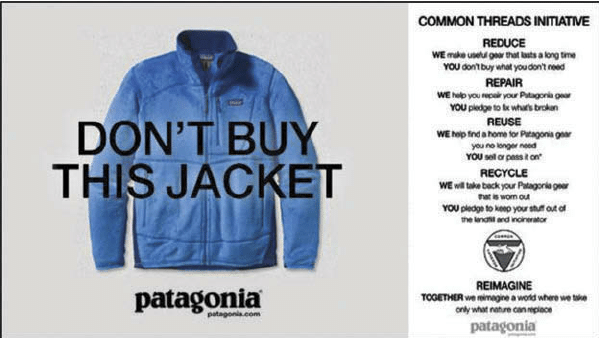
Moreover, as evident in the video above Patagonia can be shown to use the environment to gain a positive self image and self perception within their consumers and community as they aim to benefit the society and environment at large not only for this generation but to the future generations. This is shown in the above video as Patagonia suggested that consumers should reflect upon their actual needs before purchasing a product, a message discouraging consumption and encouraging more conscious and responsible buying habits.
Which enabled Patagonia to gain the personality of a company that is conscious about the environment and aims to better not only consumers but also the society and environment in which we live in, which has also contributed to their positive self image as they can be seen as a leader in sustainable movement. This has lead to Patagonia gaining a positive self image, self perception, self comparison and personality amongst their consumers.
Reference:
(1) Emeraldinsight.com. (2019). “Don’t buy this jacket”, Consumer reaction toward anti-consumption apparel advertisement, Journal of Fashion Marketing and Management: An International Journal, Accessed 18 April 2019, https://www.emeraldinsight.com/doi/full/10.1108/JFMM-12-2014-0087?fullSc=1
(2) YouTube. (2019). ‘Patagonia: The Paradox of an Eco-Conscious Company’. Accessed 18 April 2019, https://www.youtube.com/watch?v=FaK3koLyChE
(3) Mehta, A., 1999. ‘Using self-concept to assess advertising effectiveness’. Journal of Advertising Research, 39(1), pp.81-81. http://gandrllc.com/reprints/usingselfconcepttoassessadvertisingeffectiveness.pdf
(4) Moschis, G.P., 1976. Social comparison and informal group influence. Journal of Marketing Research, 13(3), pp.237-244. https://www.jstor.org/stable/3150733?seq=1#page_scan_tab_contents


